


PALILOV D.E. Political Aspects of the Transport and Logistics Northern Sea Route Project
D.E. PALILOV Postgraduate student, Financial University, under the Government of the Russian Federation Moscow, Russia
POLITICAL ASPECTS OF THE TRANSPORT AND LOGISTICS NORTHERN SEA ROUTE PROJECT
The article deals with the current problems and trends in the development of the transport and logistics Northern sea route project. It analyzes existing conditions due to which the rapid development of the Northern sea route began and its use as an important artery of international trade. The key political aspects and factors that have a direct and indirect impact on the active use of the Northern sea route are also studied. In particular, the author considers the issue of interaction between the Russian Federation and China and the role of the latter in the development of the domestic icebreaker fleet. In conclusion, the prospects for the development of the Northern sea route and mechanisms for accelerating this development are studied.
Key words: Northern sea route, political aspects, politics, political sciences, geopolitical factors, sanctions, international trade, foreign economic activity.
An increased national and international interest in the Northern sea route (Northern sea route, NSR) is due to both geopolitical processes (long-term trend towards the division of the Arctic) and the needs of the Russian Federation in the development of the Arctic zone .
In addition, the relevance of the scientific study of the influence of political aspects on the development of the Northern sea route is associated with the peculiarities of international trade between East Asia and Europe. To date, the main channel of trade is the Suez Canal, where Russia's interests are affected only indirectly. But at the same time, the influence on the activity of maritime traffic along the Northern sea route remains, and participation in it of the Chinese merchant fleet should be perceived as an increasing trend.
There is a growing interest in Arctic issues. And one of the key factors in the development of the Arctic is the Northern sea route project. A number of conditions that have developed over the past 30 years allow us to speak about the active stage of the use of this transport artery in international trade :
– beginning of legislative registration of territories and waters of the Arctic powers, including Russia, Canada, USA and Scandinavia;
– global warming, which leads to a decrease of the ice cover of the Arctic Ocean;
– search for optimal from an economic point of view transport and logistics routes of international trade;
– changing international political environment, including Russia – EU – US relations, that have worsened due to economic and political sanctions and counter-sanctions;
– emergence of new threats to international security, not only political and economic, but also environmental.
The Northern sea route is becoming an important factor in ensuring Russia's national security. This route is used to export resources from the Arctic regions, providing 12-15% of the country's GDP (picture 1). The NSR plays a key role in providing access to the world ocean for the Russian Navy. In addition, it is the most important transport artery, providing the needs of the population of the Far North and Siberia .
Picture 1
Northern sea route
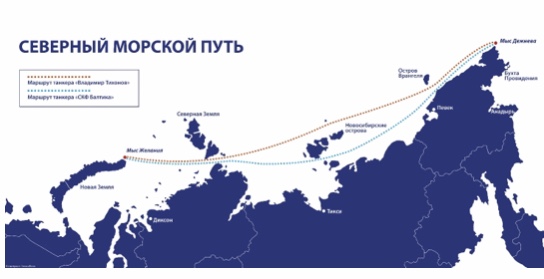
Given the role of the Northern sea route in international trade, the emergence of conflict situations between the countries of the Arctic zone is not excluded. And it has a negative impact on the efficiency of the Northern sea route transport and logistics project.
The most significant political aspect of the development of the NSR is the interaction between Russia and China. As early as 2010, the Chinese shipping companies began their first expeditions through the water spaces of the Arctic. In 2012, Rosneft and the State Development Bank of China signed a general agreement on the exploration and production of oil on the shelf of the Arctic Ocean.
Due to the serious drop in profits of Chinese shipping companies in 2012-2013, it was decided to increase the volume of expeditions along the Northern sea route. At the same time, it is expected that by 2020 every seventh Chinese ship will be sent along this route. A major part of the transportation will be ensured by the icebreaker fleet of Russia.
Due to the ratification by Russia of the 1982 UN Convention on the law of the sea on March 12, 1997, Arctic waters became "no man's land". A foreign commercial vessel may pass through the area without being obstructed by the Russian Federation. But, despite the loss of monopoly on the possession of sea waters, the Russian side has a full right to dictate the following conditions :
– mode of insurance of ships;
– organization of rescue operations;
– unique proposals of icebreaking escorts.
Based on these conditions, the Chinese side cannot do without Russia in the development of its trade routes, which implies further mutually beneficial cooperation. If the Chinese shipping companies refuse to cooperate, it will lead to a significant rise in the cost of expeditions. First, they would have to attract other foreign icebreaking escorts. Second, it will reduce the likelihood of rescue operations in online mode, thus increasing staff costs, as sailors would require monetary compensation for the high level of risk.
As one of the arguments confirming the growing political interest of the PRC in the topic of the NSR, one can cite scientific research. Countries outside the Arctic zone may claim certain rights if they conduct active research in the region. China has confirmed its partnership in the research work of the Northern sea route project with countries such as Iceland and Norway. The latter support China's application for a permanent observer status in the Arctic Council . It is Iceland and Norway that are called potential partners of shipping companies from China, which provide cargo turnover with Europe.
The Arctic Council is an international forum for the protection of the unique nature of the North polar zone. It consists of eight countries, as well as observer states, including China. From 2021 to 2023 the duties of the Chairman of the forum will be transferred to the Russian Federation. Noting that this Council does not have a direct impact on the development of the Northern sea route, it should be said that when taking protective measures to ensure the integrity of the nature of the polar zone, certain prohibitions concerning the regime of passage of ships of the countries of the region are possible. Given the dominant role of the Russian Federation in the Northern sea route project, these measures may have a negative impact on Russia's political and economic interests in the Arctic.
In order to increase its influence in the framework of international trade in raw materials and finished products, Russia needs to intensify investment in the creation and improvement of transport infrastructure, in particular, railways leading to the main seaports of the Arctic zone. Here are some investment projects of strategic importance :
– Belkomur (Arkhangelsk region – Republic of Komi-Perm region);
– BAM-sea of Okhotsk (Berkakit-Yakutsk-Magadan);
– Polar TRANS-Siberian railway with its promising access to Petropavlovsk-Kamchatka and Chukotka.
These projects require investments of about 400 billion Russian rubles. As the result of these projects, the volume of cargo transportation on the Northern sea route is expected to increase to 35-40 million tons of cargo per year. At the same time, the income of the Russian icebreaker fleet for the support of one foreign vessel will start from 100 thousand us dollars.
Approximate calculations show that up to 15 ships can be sent on an expedition per day with a possible rate of payment for escort services from 100 to 500 thousand US dollars. It should be borne in mind that the cost of using the NSR as a transport artery is higher in winter by 25%, and lower in summer – by 35% than similar ones through the Suez Canal. This makes the Northern sea route, undoubtedly, a profitable transport and logistics project and a direct competitor to the southern direction of cargo delivery from East Asia .
Even if the freight rates of the NSR are set in excess of 4 times compared to the rates for expeditions through the Suez canal, the cost of transportation of goods using the Northern sea route will be comparable to the cost of transportation through the Suez with considerably shorter time periods. And the commissioning of high-latitude deep-water routes, which run north of the Novosibirsk Islands, will allow navigation of large-tonnage vessels with a draft of more than 15 meters .
Thus, conditions will be created for the passage of heavier ships that form the basis of the Chinese merchant fleet for transportation to Europe and the West coast of the United States. The cost of escort of such a vessel by the Russian icebreaker will be about 500 thousand US dollars. A maximum of 15 vessels can be escorted per day for a total amount of 7.5 million US dollars. During the year, the maximum economic effect of such expeditions will be more than 2.7 billion US dollars.
Prospects for further development of the Northern sea route suggest an increase in Russia's activity on the issue of international cooperation with other countries of the Arctic Council. Here, the Russian side has a number of advantages :
– geographic location;
– a large number of seaports;
– highly qualified personnel for maritime transport;
– railway tracks adjacent to the sea ports of the Arctic zone;
– icebreaker fleet (Russia has 40 vessels, Finland – 7, USA – 4, Sweden and Canada 5 each, etc.).
Based on the above, we expect a strengthening of cooperation between Russia and China, key partners in international trade in raw materials and finished products. It is important to identify the existing political risks associated with the increasing role of China in the Arctic Council. In addition, it is necessary to take into account an increase in the funding of the icebreaker fleet by the USA, Canada and the Scandinavian countries, the emergence of new and modernization of existing vessels and presence of direct competitors of the Russian side, resolution of political disputes with China is quite predictable, since China is not only geographically and historically connected with Russia, but also is its strategic ally within the framework of the Shanghai cooperation organization (SCO) and the BRICS.
It is important to stress that political prospects for the development of the Northern sea route in the Russian interests are ambiguous, at least until the legislative registration of the key provisions on the use of Arctic sea routes in the "Polar Code". The Arctic Council needs to play a more significant political role, in particular, to achieve the legislative consolidation of the mandatory implementation of its decisions for all participating countries.
The analysis of the current state of the transport and logistics project Northern sea route leads to the conclusion that infrastructure projects need larger financing as they contribute to the increasing role of the Arctic zone in the spatial and economic development of Russia, it is also necessary to focus on the advanced development of the NSR in the world cargo turnover as a serious competitor to the Suez Canal.
REFERENCES:
1. Аndreeva Yu.V., Gibadulina М.М., Frolova V.А. Prospects for the influence of the Northern sea route on the development of trade between China and Europe // International journal of applied and fundamental research. – 2015. – № 8-3.
2. Fisenko А.I. The geopolitical and economic aspects of the development of the Northern sea route in Russia // Transportnoe delo v Rossii. – 2013. – № 4.
3. Fomichev A.A. Political direction of the development of the Northern sea route // Vestnik MGIMO. – 2015. – № 3 (42).
4. Hong Seryun. Cooperation of Russia with Western partners in the implementation of Arctic projects in the post-sanctions period // Issues of national and federative relations. – 2017. – № 2.
5. Ilyasov R.М. The impact of mass transport on the Northern sea route: the policy of formation of the system of environmental regulation // Issues of politology. – 2018. – № 7.
6. Martynova М.Yu., Shulenina N.V., Belyaeva V.P. Arctic vector of East Asian policy // Issues of politology. – 2018. – № 7.
7. The Northern sea route. – URL: https://regnum.ru/pictures/2322191/2.html.
8. Todorov А.А. International transit potential of the Northern sea route: economic and legal aspects. – URL: https://riss.ru/images/pdf/journal/2017/3/11.pdf.
9. Zalywski N.P. The Northern sea route: potential of expectations and real problems of functioning // Arctica I Sever. – 2015. – № 20.
10. Zonn I.S., Zhiltsov S.S. Arctic race to grab and to drill. – М., 2013.
GRISHIN О.E., КАSEM М., BELYAEVA V.P. Political Aspects of Ensuring Energy Independence of the Baltic Countries in the Electricity Sector
О.E. GRISHIN Candidate of Sciences (political sciences), Assistant Professor at the Chair of political analysis and management, Peoples’ Friendship University of Russia (RUDN University), Moscow, Russia
М. КАSEM postgraduate student at the Chair of political analysis and management, Peoples’ Friendship University of Russia (RUDN University), Moscow, Russia
V.P. BELYAEVA Deputy Director for educational work, Moscow State budgetary educational institution School# 97, Moscow, Russia
POLITICAL ASPECTS OF ENSURING ENERGY INDEPENDENCE OF THE BALTIC COUNTRIES IN THE ELECTRICITY SECTOR
The article analyzes the causes, problems and consequences of the project of withdrawal of the Baltic countries from the BRELL (Belarus, Russia, Estonia, Latvia, Lithuania) energy system. The authors consider the directions of the energy strategy of the Baltic states, including elimination of the "Baltic island" in the energy system of the European Union. It is shown that the energy infrastructure is the last area that prevents their full integration with the European Union and a break of their connections with Russia. The article reveals that the concept of energy independence of the Baltic States from Russia is openly political and contradicts the socio-economic interests. Energy independence of the Baltic States is a geopolitical project of the West with no considerations for the budgetary money or expenses of the taxpayers. As a result of the analysis of the causes and consequences of the Baltic countries' withdrawal from BRELL, the authors come to the conclusion about the political nature of the project and demonstrate problems and negative consequences of its implementation.
Key words: energy independence, the Baltic states, Russia, European Union, electric power industry, BRELL.
One of the most ambitious projects of the European Union (EU) and the Baltic states is the refusal of the latter from the infrastructure in the field of electricity common with Russia and Belarus and their disconnection until 2025 from the BRELL (Belarus, Russia, Estonia, Latvia, Lithuania) energy system and synchronization of their power grids with networks of other EU countries. So far, the BRELL energy companies have an Agreement on parallel operation of power systems dated February 7, 2001. The Baltic energy system makes up a single technological space with the Unified Energy System of Russia.
Integration with the European energy system is well founded. From the economic and technical points of view, the Baltic states should simultaneously increase energy connections with Northern Europe and Poland while maintaining BRELL. That is exactly what is happening now. But the opinion of economists and technical experts is not taken into account by the Baltic politicians. The anti-Russian policy direction of the Baltic countries, including in the energy sector, has been further strengthened in connection with the events in Ukraine, and especially after the joining of Crimea to Russia.
In 2016, Lithuania, Latvia and Estonia announced their withdrawal from BRELL in order to "gain independence from the Russian energy supply." To justify their position, politicians replaced the cause with the consequence, that is, they explained their desire to get out of BRELL by the threat from Russia. NATO is actively involved in promoting cut-off from BRELL and NATO’s "research" leads to the conclusion of the Russian energy threat to the security of the Alliance. In fact, electricity flow in the BRELL energy ring is beneficial to all its participants from an economic point of view, as the system allows maneuvers and makes it possible to import cheaper and excess electricity depending on the market or weather conditions, which is constantly happening. If the Baltic states withdraw from BRELL, it will create problems for Russia. Therefore, Russia is working on the issue of self-sufficiency of Kaliningrad. The destruction of the unified energy system may also create problems for the Belarusian NPP under construction, depriving it of the opportunity to redirect electricity at peak moments. Thus, the reason for the Russia's possible exit from BRELL is not its desire for such exit, but the need caused by the threat of the Baltic states’ withdrawal. Such project will require a lot of time and huge investments. Any scenario is costly. Another problem associated with the release of the Baltic states from BRELL is the problem of compensation to Russia and Belarus for the costs of establishing new infrastructure. And here the Baltic politicians again mix up the cause and effects, for example, the construction of nuclear and other power plants is regarded as an excuse to say that Russia demonstrates its intention to leave the energy ring therefore, it is not necessary to reimburse its costs.
To date, the European Commission and the Baltic states have agreed to find a solution to the problem of disconnection from BRELL and connection to the EU power grid by May 2018. And Russia plans to disconnect the Baltic states in the first half of 2018.
In the Baltic countries, along with a neutral and quite economically justified term "energy security", the concept of "energy independence" is used.
Energy security involves not only prevention of conflicts over energy resources, but also the expansion of access to resources. In addition, the International Energy Agency includes in energy security the possibility of access to energy resources at affordable prices .
The EU Energy Security Strategy of 2014 emphasizes the need to address the energy independence of some countries (Estonia, Latvia, and Lithuania, Central and Eastern Europe) from Russia . In particular, the Baltic countries themselves hold a special opinion on energy policy towards Russia, their priority is energy independence, that is, a political approach . Although the achievement of energy independence from Russia in official sources is indicated by a neutral term "energy security" , in fact, the main focus of the energy strategy of the Baltic states is the elimination of the "Baltic island" in the European energy system. And the energy infrastructure is the last area that does not permit their full integration into the European Union and the breaking of the link with Russia .
Each country considers the concept of energy security insofar as it is applicable to its conditions. And in the situation of the Baltic States, the conditions of the countries are not taken into account as the concept of energy independence from Russia is openly political and contradicts the socio-economic interests of the states. That is, the economy and the population will be sacrificed to the geopolitical interests of the West .
The Analytical report "Relations between Russia and the Baltic states: from missed opportunities to real prospects" (hereinafter – the "Analytical report") assesses the struggle for energy independence from Russia as irrational from the economic point of view . Thus, the energy independence of the Baltic states is a geopolitical project, which does not take into the account either the budget money or the expenses of taxpayers. But another component of this project is worth noting, it is the desire of the West to break the energy ties of the Baltic states with Russia due to the fact that such break will prevent the return of the Baltic countries to the sphere of influence of their Eastern neighbor, as it happened in the middle of the twentieth century. In this way, the energy independence also has a preventive aspect. So, the strategy of energy independence is irrational from the point of view of interests of the Baltic States and it is rational from the point of view of geopolitical interests of the West .
One of the most ambitious projects of the European Union and the Baltic states is the refusal of the Baltic countries from the infrastructure in the field of electricity, common with Russia and Belarus, disconnection until 2025 from the BRELL energy system (Belarus, Russia, Estonia, Latvia, Lithuania) and synchronization of the power grids with the networks of other EU countries. As V.V. Vorotnikov emphasizes: "In general, policy associated with the overcoming by the Baltic countries of their infrastructural "isolation" corresponds to the main EU objectives in the field of infrastructural integration and is simultaneously connected with another specific feature of the Baltic states’ foreign policy, immanent confrontation with Russia" .
The collapse of the Soviet Union was politically simpler than the division of a single energy infrastructure. So far, the BRELL energy companies have an Agreement on parallel operation of power systems dated February 7, 2001 . The Baltic energy systems make up a single technological space with the Unified Energy System of Russia .
But the politicians of the Baltic countries believe such structure to be unacceptable. Minister of economics of Estonia Johan Parts in 2013 said that the withdrawal of the Baltics out of BRELL is inevitable and it is necessary to integrate into the European energy system . The authors agree with the position of the Analytical report that the integration with the European energy system is quite justified. From the economic and technical points of view, the Baltic states should simultaneously increase energy connections with Northern Europe and Poland, while maintaining BRELL. That is exactly what is happening now. But the opinion of economists and technical experts is not taken into account by Baltic politicians .
As has already been noted, the anti-Russian direction of the policy of the Baltic countries, including in the sphere of energy, has been further strengthened in connection with the events in Ukraine and especially after the joining of Crimea to Russia .
Currently, the energy systems of the Baltic countries fall short of the demand . In 2016, Lithuania, Latvia and Estonia announced their withdrawal from BRELL in order to "gain independence from the Russian energy supply." According to many experts, this step was a political decision . In particular, Jussi Jurinsalo, Director of the network company Fingrid, believes that the synchronization itself is a political issue and from the economic point of view it is necessary to carry out the energy exchange between the Baltic countries .
To justify their position, politicians replace the cause with the consequence, that is, the desire to get out of BRELL is explained by threats from Russia. For example, President of Estonia Kersti Kaljulaid in an interview with the Washington Post said that he does not exclude an attack by Russia on the communication lines, and in particular "a shutdown of some power systems" . Advisor to the Lithuanian Minister of energy Aurelia Wernickaite also claims that Russia itself is preparing to disconnect the Baltic states from BRELL, she is echoed by the Deputy of the Lithuanian Seimas Paulus Saugardas stressing that for Russia blackmail is a common practice and geopolitical weapon . NATO actively participates in promoting disconnection from BRELL and its "research" leads to the conclusion of the Russian energy threat to the security of the Alliance . In addition, politicians from the Baltic states speak about the withdrawal from BRELL implying the electricity problem for the Kaliningrad region, as a positive development. If their decision on the disconnection from BRELL they call a break from the "past occupation", it is quite logical that the intention of Russia to disconnect the Baltic states from BRELL after such statements they call "energy blackmail" and an "aggression against neighbors" .
In fact, electricity flows in the BRELL energy ring are beneficial to all its participants from an economic point of view, as the system allows maneuvers and makes it possible to import cheaper and excess electricity depending on the market or weather conditions, which is constantly happening. If the Baltic states get out of BRELL, then, noted General Director of the energy development Fund Andrey Listovsky, it will create problems for Russia . In particular, the Kaliningrad region is supplied with electricity through Lithuania and in winter St. Petersburg uses Latvian gas storage facilities. Therefore, Russia is working on the issue of self-sufficiency of Kaliningrad . The destruction of the unified energy system may also create problems for the Belarusian NPP that is being constructed now, depriving it of the opportunity to redirect electricity at peak moments . Thus, the reason for the Russia's possible exit from BRELL is not its desire for such exit, but the need caused by the threat of the withdrawal of the Baltic states.
In this regard, back in 2015, Russian President Vladimir Putin decided that it was necessary to ensure reliable energy supply to the Kaliningrad region, in particular, to resume the construction of the Baltic nuclear power plant . In 2017, in an interview with the American TV channel CBS, Vladimir Putin said that the synchronization of the Baltic electricity networks with the EU can isolate some areas of Russia: "This means that between some regions of the Russian Federation there will be zones with no power lines... and we will have to spend billions of dollars to build this system, whereas our European partners will also have to spend billions of dollars to include the Baltic countries in their energy ring" .
But for the Baltic states, an exit from BRELL will not be easy either. Such project will require a lot of time and huge investments. A part of the costs will be covered from the EU infrastructure funds, but the main costs will be ultimately covered by electricity consumers . As to the European funding, in addition to timely submitting the budgetary funding request to the European Commission for the years 2020 to 2026, the Baltic countries will have to develop their own unified draft of connection to the EU infrastructure, to the detriment of their ambitions .
Currently, the EU Joint Research Center is considering various synchronization scenarios: via Poland by land or via Northern Europe through submarine cable. It is possible to exit BRELL without synchronization, but in any case, the withdrawal, according to the Baltic states, is inevitable. Any scenario involves high costs, and the connection through the submarine cable is fraught with frequent accidents. Some Baltic politicians still have doubts about the reasonableness of a full exit from BRELL. Thus, Vice-Chairman of the Committee of the Seimas of Lithuania on budget and finance Kestutis Glaveckas believes that the exit of Lithuania from BRELL is a political decision, and a greater number of backup connections would be more reliable [BEMIP: scenarios…, 2017]. Finland may serve as an example of a practical attitude to the energy market, it imports electricity from the Russian Federation, and then directs part of it to Lithuania via Estlink .
Another problem associated with the release of the Baltic states from BRELL is the problem of compensation to Russia and Belarus for the costs of establishing new infrastructure. And here the Baltic politicians again mix up the cause and effects, for example, the construction of nuclear and other power plants is regarded as an excuse to say that Russia demonstrates its intention to leave the energy ring, therefore, it is not necessary to reimburse its costs .
To date, the European Commission and the Baltic states have agreed to find a solution to the problem of disconnection from BRELL and connection to the EU power grid by May 2018. And Russia plans to disconnect the Baltic states in the first half of 2018 .
In the article devoted to the Rail Baltica project N. M. Mezhevich emphasized that "large infrastructure projects are a recognized driver of the national economy in any country." But in the Baltic states, these projects, contrary to economic realities, are aimed "at achieving a falsely understood geo-economic independence," and such projects may eventually become not a driver, but a destabilizing factor for the economy of these countries . All of the above is fully applicable to the project of disconnection from BRELL.
Summing up the analysis of the causes and consequences of the Baltic countries' withdrawal from BRELL, the following conclusions can be drawn:
1) the project is political in nature and is a geopolitical project of the West;
2) the implementation of the project will bring unjustified costs to the Baltic countries themselves, as well as to Russia and Belarus;
3) the most acceptable to all BRELL participants, would be connection of Baltic countries to the EU electricity supply system with the preservation of the BRELL electricity grid.
The desire of the West to break the energy ties of the Baltic states with Russia is conditioned by the fact that such break will not allow the Baltic countries to return to the sphere of influence of their Eastern neighbor, as it happened in the middle of the twentieth century. In this sense, the energy independence also has a preventive aspect.
REFERENCES:
1. Agreement among GPO "Belenergo", JSC "FGC UES", JSC "SO UES", JSC "Augstsprieguma tikls", "Elering OU" and ZAO "LITGRID" on parallel operation of energy systems of 07.02.2001. – URL: http://www.so-ups.ru/fileadmin/files/company/international/icdevelopment/BRELL/BRELL_Agreement_051015.pdf.
2. Annual Report of the Minister of foreign affairs on the achieved results and future work in the field of foreign policy of the country and on the European Union. – Riga, 2016. – URL: http://www.mfa.gov.lv/images/AM_05012016_rus.pdf.
3. Communication from the Commission to the European Parliament and the Council. European Energy Security Strategy. 28.05.2014. COM (2014) 330. – Brussels, 2014.
4. Countries of the anti-Russian "sanitary cordon" exist only as geopolitical projects of the West. 2018. – URL: http://www.regnum.ru/news/polit/1882794.html.
5. Decline of BRELL. What will the rupture of energy ties with the Baltic states mean for the Union? 26.10.2017. – URL: https://www.sonar2050.org/publications/k-gryadushchemu-zakatu-brell-chem-zanyatsya-soyuznoy-energetike/.
6. Каsem М.F. The political component of Russian-Latvian relations at the present stage (2014-early 2017) // Problems of the post-Soviet space. – 2017. – 4 (2):169-175. DOI: 10.24975/2313-8920-2017-4-2-169-175.
7. Kasem М.F. Europe's energy security: confrontation between the US and Russia // PolitBook. – 2017. – № 2.
8. Kasem М.F. Energy independence of the Baltic states: the influence of geopolitics on the economy // Problems of the post-Soviet space. – 2016. – 4:90-100. DOI: 10.24975/2313-8920-2016--4-90-100.
9. Mezhevich N.М. Rail Baltica: between the economic absurd and political crisis. 22.01.2018. – URL: https://baltstudies.ru/smi/rail-baltica-mezhdu-ekonomicheskim-absurdom-i-politicheskim-krizisom/.
10. Мiroslavov О. "Escape" of the Baltic states from BRELL may be left without European funding. 26.12.2017. – URL: https://realnewsland.ru/articles/51509-pobeg-pribaltiki-iz-brell-mozhet-ostatsya-bez-evropejskogo-finansirovaniya.html.
11. Niemelaynen Y. The Baltic states want to secede from the Russian power system. They hope to join the European Union by 2025. 27.06.2017. – URL: http://inosmi.ru/economic/20170627/239684063.html.
12. Nosovich A. Russia can fulfill the dream of the Baltic states on their disconnection from BRELL. 13.09.2017. – URL: https://www.rubaltic.ru/article/ekonomika-i-biznes/13092017-rossiya-mozhet-ispolnit-mechty-pribaltiki-otklyuchit-ot-brell/.
13. Polozkova A. Energy suicide: why do the Baltic states run away from BRELL? 14.05.2017. – URL: http://minenergo.gov.by/wp-content/uploads/RF-6.doc.
14. Relations between Russia and the Baltic states: from missed opportunities to real prospects. Analytical report / Collective of authors headed by N.М. Меzhevich. – SPb: SPGU, 2013.
15. Seliverstov S.S. Cross-border cooperation between Russia and the EU in the field of electric power: key directions and prospects // Joint conference of EURELECTRIC and CIS EEC, October 3, 2012 – Brussels, 2012.
16. Shulga I. Reforming the power industry of the Baltic States // Energy market. – 2018. – № 4. – URL: http://www.e-m.ru/archive/articleser.asp?aid=5215.
17. The common power grid with Russia creates tension in the Baltics. 2013. – URL: https://russian.rt.com/inotv/2012-12-15/Obshhaya-elektroset-s-Rossiej-sozdaet.
18. The President of Estonia does not exclude that Putin can turn off the power supply to NATO countries. 24.03.2017. – URL: http://baltnews.ee/mir/20170324/1015828564.html.
19. The Baltic states will resolve the issue of synchronization of power grids with the EU by May 2017. 20.12.2017. – URL: https://eadaily.com/ru/news/2017/12/20/pribaltika-reshit-vopros-sinhronizacii-energosetey-s-es-k-mayu.
20. Vladimir Putin criticizes plans to connect the electricity systems of the Baltic states and Western Europe. 29.09.2015. – URL: http://www.kurier.lt/v-putin-kritikuet-plany-soedinit-elektroenergeticheskie-sistemy-stran-baltii-i-zapadnoj-evropy/.
21. Vorotnikov V.V. 25 years of independence of the Baltic States: from the Soviet to the European Union // Contours of global transformations. – 2016. – Issue 5. – V. 9.
PRYAKHIN V.F. Prospects of Korean Settlement
V.F. PRYAKHIN Doctor of political sciences, Professor at the Chair of foreign regional studies and Russian foreign policy, State University for Humanities, Professor at the Chair of diplomacy, MGIMO, Moscow, Russia
PROSPECTS OF KOREAN SETTLEMENT
The complex set of problems around the situation in the Korean Peninsula is not accidentally called a kind of "Gordian knot" of world politics of our days. Unfortunately, attempts to cut this knot with one blow of a sword as it did Alexander the Great in the IV century BC, are fraught in the XXI century with the disasters of regional and global character. The author of the article below uses his experience in conflict-prone areas to present a possible scenario of political and diplomatic denouement of the Korean Gordian knot.
Key words: DPRK, Republic of Korea, USA, China, Russia, UN, the prospects for resolving the problem of non-proliferation of nuclear weapons, denuclearization, inter-Korean negotiations, Korean reunification, the Peace Treaty, the world order, hegemony, multi-polarity.
Any attempt to resolve a complex Korean equation with many unknowns must come from objective realities. This explains, in particular, the success of the Russian-Chinese road map proposed in 2017 . Although at the time of its presentation there were skeptical voices, nevertheless, the actual achievements in solving Korean problems in 2018 were achieved precisely along the path of the above realistic scenario. Therefore, any approach to the "Gordian knot" of the Korean Peninsula should begin with an inventory of the interests of the parties-participants, without which the settlement is simply impossible. Among them are:
• the will of the international community to respect the nuclear non-proliferation regime and the denuclearization of the Korean Peninsula;
• North and South Koreans' desire for reunification;
• the political will of South Koreans to live in accordance with Western notions of democracy and human rights;
• North Koreans' support for the current social and economic system in their country;
• the imperative of U.S. policy prohibiting the possession by DPRK's nuclear missile complex;
• inadmissibility of such a decision for Beijing and Moscow, under which US troops would go to the border of Korea with China and Russia.
At the same time, it should be borne in mind that the above interests should not be met in any order of priority, but, as far as possible, simultaneously. This simultaneousness should be ensured by constant rounds of multilateral and bilateral negotiations, primarily in the format of the "six" nations (North Korea, Republic of Korea, China, Russia, USA, Japan), as well as on a wider platform.
The best starting point for the process would be a joint Declaration of commitment by the parties to respect the above principles of six nations.
The first practical step towards a settlement should be the signing of a peace Treaty, drawing a line under the war of 1950-1953.
There is currently quite a lot of discussion about who should sign the treaty. After all, the famous armistice agreement 1953 was concluded between four parties, including in addition to the Korean representatives an American General and a Chinese commander of the people's volunteers.
This debate seems to be of a scholastic nature and is initiated by those who do not wish to allow any Peace Treaty to be signed. In fact, the war in Korea began as a civil war between nationalists and Communists, and representatives of those parties, i.e. the Republic of Korea and the Democratic People's Republic of Korea, must sign the Peace Treaty. By signing the Treaty, the parties would give up their ambitions to extend their political systems and ideological paradigms of thinking to the entire Peninsula and thereby satisfy the two most important priorities of the General scheme of solving the Gordian knot problems.
Of course, a peace treaty will be effective if and only if its implementation is most serious way (in the terminology of the Russian Foreign Ministry – "reinforced concrete guaranteed" ). It appears that any such set of "reinforced concrete" guarantees should include the following imperatives:
• mutual withdrawal of troops from the demarcation line to a possibly greater (not less than 100 km) distance. Only limited contingents of police officers armed with personal weapons can be deployed directly on the demarcation line;
• downsizing of the armed forces of both Korean states to a reasonable minimum;
• giving the demarcation line the status of a state border. Opening of a certain number of checkpoints on the state border, sufficient for economic cooperation and humanitarian contacts between the two Korean states as well as international transit;
• formation of inter-Korean cooperation bodies on the confederate basis; a deployment in the demarcation zone of the UN peacekeeping forces. Units of such forces (land, sea and air) should have effective powers (UN mandate) and material resources to prevent a conflict between the two Korean states; stage-by-stage elimination of North Korean nuclear missile potential, synchronized with the termination of the US military presence on the Korean Peninsula and the adjacent Pacific ocean. The first stage is placing the DPRK's nuclear missile forces under IAEA control. The second is their withdrawal and storage in one zone under international control on the territory of the DPRK. The third stage is the removal of all components of the nuclear missile potential outside the DPRK. The fourth stage is the destruction of all components of the nuclear missile potential, as well as capacities and research centers for their production and upgrading. At the same time, it is meant that the us military presence on the Peninsula and in the relevant water area should be terminated, at least, by the end of the second stage of the denuclearization schedule;
• establishment of the International Inter-Korean Settlement Fund under the auspices of the World Bank and the International Monetary Fund.
As of today, the most controversial and problematic point of this program is the elimination of the US military presence on the Peninsula. The United States itself will strongly be against it, at least under the D. Trump Administration, part of the South Korean elite and, of course, Tokyo. Meanwhile, there are no legal impediments to such act, as there is no risk for the White House to "lose face." After all, though many people do not remember this now, the official status of American troops in Korea is "UN troops". Therefore, a comprehensive plan of inter-Korean settlement can and should organically include nothing else, but an ordinary "rotation" of the peacekeeping contingent.
The renewed peacekeeping contingent, in agreement with the signatories to the peace Treaty, should include troops from neutral and non-aligned States. The ideal candidate for this function seems to be India, as a state on the one hand neutral, authoritative, and on the other-having enough powerful armed forces to ensure the implementation of peacekeeping powers.
In favor of India as a participant in the inter-Korean settlement also speaks the fact of the cultural and historic ties between the two peoples. Chronicles say that in 49 BC Indian Princess Alodia married Korean King Kim Suro. Another cultural feature that unites the countries is Buddhism, which came to Korea from India in the fourth century. In the twentieth century, Delhi was not indifferent to the vicissitudes in the Peninsula: 350 Indian doctors during the civil war provided assistance to both military and civilian population. In the difficult years of the 90s, when North Korea was left without the assistance of its such traditional donor as the USSR, India provided significant food aid to the starving Koreans. In the XXI century (before the adoption of the UN Security Council sanctions), a significant trade turnover of one billion US dollars has developed between the two countries. There is also a very significant experience of Delhi's participation in the UN activities on the Peninsula. In 1947, India was Chairman of the nine-party UN Commission which oversaw the process of the division of Korea. After the Korean war, India once again played an important role as Chairman of the Independent Commission for the repatriation of peoples on the Korean Peninsula.
Of course, the Indian component of the peacekeeping force could be supplemented by contingents from ASEAN countries, as well as possibly from other geographical areas. To a large extent, this is a matter of financial resources and considerable resources. Therefore, the plan provides for the establishment of a special Fund for Inter-Korean Settlement. It appears that the selection of potential donors to the Fund should be reconciled with the practical realization of the denuclearization timelines.
In general, the issue of synchronizing the process of inter-Korean settlement and denuclearization of the Peninsula is the central and most difficult one in that Gordian knot. First, because there is more than interpretation of this concept. For Washington, denuclearization is primarily and mainly is the elimination of the North Korean nuclear weapons and launch vehicles. But other participants in the process believe that this should include the withdrawal of the American military contingent of almost thirty thousand troops from the territory of South Korea and the US guarantees to abandon any placement of nuclear charges near the Korean coast plus the refusal to use nuclear weapons against the DPRK. Second, because Pyongyang deftly linked concessions on its missile and nuclear complex, including elimination of the resonance range in Bhongiri, with the theme of Korean reunification.
Whatever was said by the official representatives of the United States, the theme of Korean reunification, so close to the hearts of all Koreans, is, at least, of no interest to the American political elite, and in fact people in Washington are so fond of Korea that they prefer to have just two. This follows logically from the ancient "divide and rule" principle. Thus, in February 2018, Pyongyang managed to launch two tracks of the Korean settlement – the track of denuclearization and the track of reunification. But the North Koreans, by no means, intend to give the question of synchronizing these processes to Washington. Pyongyang understands well how important it is for the White House to approach the midterm elections to the US Congress on November 6, 2018, with at least some success in eliminating the "North Korean nuclear threat." That is why on the eve of these elections, the DPRK Foreign Ministry issued an official statement saying that North Korea is ready to resume the policy of building up its nuclear arsenal if the US does not begin to lift economic sanctions against it .
Thus, Washington is clearly given to understand that the elimination of one landfill is far from a solution to the entire problem of North Korean nuclear potential. But the train of inter-Korean talks on reunification, skillfully started during the so-called Olympic pause in February 2018, has already picked up speed and it will not be easy for the Americans to stop it, at least without the risk of causing serious complications in relations with South Korean allies. Therefore, counter concessions from Washington seem to date not such a high price for their acquiescence to Pyongyang's agreeing to a meeting in Singapore.
The question remains about the pace and timing of Korean reunification on a confederation basis. As long as the reunification is not practical, all the actors of the "Gordian knot" do not skimp on the words in support of the restoration of the Korean unity. In fact, the formation of a powerful economic complex with a population of seventy-five million people in the heart of the promising Asia-Pacific region does not appeal to those financial and economic circles that have long considered themselves not only regional leaders in the Asia-Pacific region, but also the hegemons of the world economy as a whole. In this regard, the statement of President Obama about the ambitious plan of the TRANS-Pacific partnership (the TPP): "The world has changed. And the rules are changing with it. They should be installed by the US and not countries like China. Let's take this opportunity to ratify the TRANS-Pacific partnership and make sure that America not only does not lose its stake, but also dictates the rules." But it is becoming increasingly difficult to dictate the rules even for such a powerful nation as the United States, especially, when we are talking about the powerful desire of a multimillion nation to unite. As for the Koreans in the North of the Peninsula, they still consider themselves a single nation with the southerners living under American occupation. But there is a desire to unite in the South as well. According to the results of a public opinion poll conducted by the Center for reunification and peace at Seoul State University, 59.8% of South Koreans are in favor of unification with the DPRK. 45.1% of advocates of reunification believe that it is necessary for the unity of the Korean people, 31.4% saw it as a necessity for eliminating the threat of war, 12.9% consider it a condition for the transformation of a United Korea into a developed country" .
Of all the states in the region, Russia is perhaps most interested in the reunification of Korea. The restoration, or rather unblocking, of the TRANS-Korean railway would open a powerful flow of goods to Europe through Russia, both from South Korea and from Japan. The importance of this transport artery is evidenced by the fact that at the mention of it, experts raise the topic of the implementation of the now seemingly fantastic project of one hundred eighty-two kilometer tunnel from the Japanese Islands to Busan on the southern tip of the Korean Peninsula .
According to skeptics, the implementation of projects of a confederate reunification will inevitably be blocked by the political elite of the DPRK as soon as it will face the establishment of a large-scale cooperation and humanitarian contacts with the South of the Peninsula. They say that millions of North Koreans, having tasted the fruits of democracy and economic prosperity of the South, will immediately overthrow the totalitarian North Korean regime.
It is characteristic that this argument is most often used by those who have never been to Korea and judge the political situation on the Peninsula, using Western stereotypes of thinking. As for, for example, Russian specialists working in the DPRK, in their opinion, the calculations to undermine the situation in the country from the inside are devoid of any grounds. For example, General Director of Rasonkontrans, Russian-North Korean joint venture, I. Tonkih believes that "the North Koreans, are already monolithic, united and have an absolutely clear understanding that they are a single nation. Therefore, I would not say that sanctions can somehow shake them from the inside or pit the classes against each other. There are no classes there, there is one single nation" .
Throughout the life of three generations, North Korea has developed its own stereotypes of thinking and values, including loyalty to the leadership of the state. This is the history of the country. And people are not ready to give it up. They understand that the southerners may live materially better, but as long as there are American troops in South Korea, Seoul will be regarded as Washington's "puppet" in the world politics. In contrast, Pyongyang pursues an independent course in both domestic and foreign policy. This cannot but impress the masses of Koreans, and not only in the North of the Peninsula.
In addition, the DPRK is carrying out economic reforms, opening the way for private initiative and entrepreneurship, developing private property, raising living standards, including its components, which are unknown in the South. In these circumstances, the current political elite of the DPRK has a real chance of survival and a worthy place in the political structure of the future Korean Confederation. The main thing for the Koreans-both in the South and in the North - is to get rid of the humiliating situation when the fate of the country is decided abroad. And in this regard, the DPRK is an example for South Korea, because despite all the difficulties Pyongyang has created a state whose ethical values can be questioned, but hardly anyone will challenge the truly independent nature of Pyongyang's policy after the leader of the most powerful state in the world "descended" to a separate summit with the leader of the DPRK.
***
The Gordian knot of inter-Korean settlement and denuclearization of the Korean Peninsula is certainly complicated. But this complexity should be an incentive for vigorous attempts to untie it, not an excuse for passivity in anticipation of it being untied "on its own". Such expectation is fraught with disaster and, by no means, through the fault of the Korean parties, but due to the inability of non-regional forces to abandon their hegemonic approaches and ambitions. The world is becoming multipolar before our eyes. Indirectly, the White House was forced to recognize this, explaining its position on the Intermediate-range Missile Treaty by the presence of third countries in addition to the signatories of the current INF Treaty. And in this multipolar world, a real solution to complex problems can be found only with respect for the interests of all participants in a given situation.
REFERENCES:
1. Almost 60% of South Koreans support unification with the DPRK. - October 2, 2018. Izvestia information portal. – URL: iz.ru/795442/2018-10-02/pochti-60-zhitelei-iuzhnoi-korei-vystupaiut-za-obedinenie-s-knd.
2. Experts spoke about the situation on the Korean Peninsula. Information portal – MK.ru electronic periodical. – 10.05.2018. – URL: https://vlad.mk.ru/social/2018/05/10/eksperty-rasskazali-o-situacii-na-koreyskom-poluostrove.html.
3. Japan and South Korea will be linked by the peace tunnel. TsIAN Information portal. February 15, 2008. – URL: https://www.cian.ru/novosti-japoniju-i-juzhnuju-koreju-svjazhet-tunnel-mira-222712/.
4. Joint statement by the Ministry of Foreign Affairs of the Russian Federation and the Ministry of Foreign Affairs of the People's Republic of China on the Korean Peninsula. 14 July 2017. Information portal of the MFA of Russia. – URL: http://www.mid.ru/foreign_policy/news/-/asset_publisher/cKNonkJE02Bw/content/id/2807662.
5. President Obama: The TPP would let America, not China, lead the way on global trade, the Washington Post, May 2, 2016.
6. Speech and answers to media questions by Russian Foreign Minister Sergey Lavrov following talks with Foreign Minister of the DPRK Lee Yong-Ho. Moscow, 10 April 2018. Information portal of the Russian Foreign Ministry. Document 674-10-04-2018. – URL: http://www.mid.ru/main_fr/-/asset_publisher/G51iJnfMMNKX/content/id/3162263.
VALIEV J.Sh.Muslim Minorities in Germany: the History of Labour Migration and the State of Social Dialogue
J.Sh. VALIEV Post-graduate student at the Department of politology and mass communications of the Financial University under the Government of the Russian Federation, Moscow, Russia
MUSLIM MINORITIES IN GERMANY: THE HISTORY OF LABOUR MIGRATION AND THE STATE OF SOCIAL DIALOGUE
The article considers the issue of Muslim migration to Germany. A brief history of labour migration in the post-war period is given. The author discusses the existing cultural contradictions between Muslim migrants and the host Europeans. The author analyzes efforts of the German Federal Government aimed at the dialogue of cultures and integration of Muslim migrants.
Key words: migration to Germany, Muslim minority, host society, cultural contradictions, integration programs and processes.
The analysis of the migration history to Germany demonstrates that migrants with different starting opportunities and cultural resources arrived in Germany at different times. On this basis, it was expected that the dynamics of successful integration would be driven by their cultural background. Low integration or even the observed segregation of foreigners finds explanation in the history of the labour migration to Germany during the years from 1955 to 1973 .
Germany at that time experienced an acute shortage of labor. In that time period, a total of 14 million "guest workers" from Italy, Yugoslavia, Morocco, Tunisia and Turkey arrived in Germany . The dominating concept in the host country was that the workers arriving in Germany occupy a niche in the labour market in which employees with low level and quality of professional qualification were in demand. These people were supposed to leave Germany in rotation after a certain time. Despite the illusory nature of such concept, no one attempted to regulate integration processes, nor did anyone tried to monitor the processes of visible demographic changes through the use of tools controlling labour migration.
Based on the then understanding that Germany was not a country of traditional immigration, the development of an integration concept was not considered necessary. An end in the recruitment and reception of labour migrants in 1973 opened up previously unaccounted consequences: migrant workers remained in Germany and the process of family reunification had begun. Integration was the subject of political debate, however, without repercussions for the continued immigration.
This background to the current integration problems explains why certain ethnic groups have insufficient resources and weak starting points for successful integration. This in turn explains the low language and educational indicators, the level of education, the difficult access to the labour market and, as a consequence, the low participation in the social processes in Germany.
Only in the last 15 years has the integration of migrants and their families been brought to the center of public debate. Since the beginning of 2000, there has been a clear trend in the migration and integration paradigm of Germany. With the understanding of the immigration attractiveness of Germany, including at the political level, the prerequisites for a system integration policy are formed. The integration of immigrants not only into the labour market but also into the social processes of the host society is becoming an integral part of a broad political concept.
As of 2014, 16.4 million people with a so-called migration history lived in Germany. They constituted 20.3% of the total population of Germany. Most of them, 9.2 million were German citizens and 7.2 million were foreigners. A fourth of them were Muslims, half of whom were German citizens .
Today, the topics of Islam and Muslims in Germany are of particular relevance and importance. After the attacks in Paris in November 2015, the relationship between the Muslim community and the state once again became a topic of contentious debate in many European countries. Against the background of the current migration of refugees to Germany and Europe, the content of the discussions is reduced to the question of how the state should behave towards refugees of the Muslim faith and how the successful integration of Muslim migrants should be carried out.
In fact, such thematic debates lack the religious knowledge. The content of Muslim religion remains blank for their participants. Therefore, Islam as a religion plays almost no role in the debate about Muslims. Such Muslim-free "labeling of Islam" actually discusses issues of exclusively integration and migration content, as well as security issues. Religion is more of a contour that allows the discussion of Islam in a structure in which violence, extremism, crime, the suppression of women's rights, the lack of democracy and "parallel" societies are perceived as attributes of Muslim identity. Thus, the issue of the need for the integration of migrants of the Muslim faith is constantly singled out from the subtext of the discussions.
The mass media play a special role in shaping the culture of discussions on the above topic. In the late 90's, the media, the scientific community and German politicians were united in considering Islam is a "brake" to the integration of migrants. During the 1970s, the phase of the employment-based immigration from Turkey to Germany, Islam was not a subject of public attention. Only after the terrorist attacks of September 11, 2001 did Islam move to the top of the security agenda . At the same time, Islam is increasingly associated with such categories as terrorism, war and armed conflict. Since that time, there has been a steady public interest in Islam, which is always supported by media attention. The content of discussions about Islam, which are conducted in Germany, is considered mainly in connection with the religiosity of Muslims and the notorious disintegration.
Is Islam integrated into the host society? Is it (also) part of Germany? Does Islam belong to Germany or not? These and similar issues are raised and addressed almost daily by civil society and political leadership, either in the affirmative or in the negative. At the same time, it is extremely important to urgently resolve another question: is social integration possible at all, taking into account the religious disposition of migrants? And whether it is necessary? There is a gap in the knowledge regarding religiously-motivated behavior and lifestyle of Muslims in Germany. Knowledge about the Muslim religion must make the debates more objective and replace the guesswork.
In this regard, it is necessary to mention the politician and publicist Thilo Sarracin, whose book "Germany is self-destructing: how the fate of the country was put at stake" has gained great popularity against the backdrop of growing Islamophobia in German society. In his book, Sarracin, based on the results of his own pseudoscientific research, substantiates the genetic inability of migrants of Muslim origin in Germany to personal growth and questions the possibility of their successful integration into German society and peaceful coexistence of East and West civilizations. In his work, Thilo Sarracin calls migrants of Arab and Turkish origin "reproducers of wrapped heads" . Although most of the hypotheses presented in his book have not been scientifically confirmed, the results of the sociological studies conducted in 2014 showed that up to 80% of respondents agreed with the conclusions given in Sarracin's book about the existing insurmountable cultural distance between Muslims and residents of Germany that can be explained by Muslim origin of the migrants .
In September 2006, Federal Minister of the Interior Wolfgang Schäuble, acting within the framework of the so-called "Integration consensus" in force at the time of the "Grand coalition," convened the German Islamic conference to create conditions for determining the policy of relations between representatives of German Islam, society and politics. Prior to that, in June 2006, the National Integration Summit was held at the initiative of the Federal Chancellor of Germany. While the Summit discusses issues aimed at the integration of all immigrants, the specificity of the Islamic conference is the creation of conditions for the functioning of the forum, which discusses and resolves issues of relations between the society and Muslims living in Germany.
The convening of the first stage of the German Islamic conference, the leitmotif of which is "Muslims of Germany are German Muslims", was aimed at improving the conditions of religious, legal and socio-political integration of Muslims in Germany. At the same time, the process of formation of the Conference participants reflected the uncertainty of the situation. Among its participants, who were selected and agreed upon by the Federal Government, were among others consistent critics of Islam. This reflected on the quality and fruitfulness of the certain discussions . Subsequently, a number of studies on Islamic topics were carried out in Germany in a short period of time. At the same time, the studies themselves have come to different and partly contradictory results and conclusions. The analysis of the results of all studies conducted with the financial support of the Federal Ministry of Internal Affairs shows that the political paradigm of the head of the agency each time determined the direction and affected the results of research.
Responding to the call to join the discussion on regarding the existence of a social and political crisis in the integration of Muslim migrants into the German society, we can agree with certain criticisms. In particular, with the fact that Sarracin was right, although in his book he has deliberately exaggerated the problem of isolation of the migrant community within the German-speaking society and the lack of mutual desire to overcome such isolation, or at least to reduce it. However, Sarracin placed the responsibility for the integration failures on one side, while integration is a process of mutual transformation, the success of which depends on the quality of mutual information exchange and the definition by the political elite of the priorities for joint coexistence and interaction.
Despite the fact that the scientific community of Germany consistently conducts observations and studies of religiously-motivated behavior of migrants of Muslim religion, the mutual influence of the religiosity and the integration process has not been sufficiently studied. German researchers, among them Yasmine El Menouar, Foroutan Naika and Haji Khalil Usludjan believe that such relationship is multi-layered and cannot be uniquely appreciated by a plus sign or a minus sign. In support of this, we can observe both positive and negative examples of the behavior of migrants of the Muslim faith in the conditions of the European democracies. These examples clearly show that, depending on the conditions and the environment, religious capital can be seen as both a brake and a catalyst for the successful integration. Therefore, in the context of modern transnational challenges and threats, the issue of integration of a Muslim into the European society becomes not only social, but also political. Under what conditions is the qualitative integration of Muslim migrants possible? How does the religious disposition affect it? What political and scientific efforts should be made for this purpose? Answers to these and other questions can be obtained in the course of fundamental and large-scale research, the need for which is obvious. The results of such studies, which will help to gain a broad understanding of the importance of a religious resource for the integration of Muslim migrants in a foreign cultural society, will be useful to a wide range of consumers, including representatives of the political elite and civil society, as well as other religious groups in modern Germany.
REFERENCES:
1. Volobuev K.V. On the issue of the legal protection of migrants // Eurasian Union: issues of international relations. – 2017. – No. 1.
2. Davydov V.N., Savina P.G., Antonio N.G.A. Africa ‒ EU: migration dissonance. – Dusseldorf, 2016.
3. Zhurbina N.E. Structure and dynamics of immigration flows to Germany in 2016-2017 // Issues of national and federative relations. – 2018. – V. 8. – No. 4.
4. Zhurbina N.E. The political challenges of labour migration in Europe // Issues of politology. – 2018. – V. 8. – No. 8.
5. Medvedev N.P. Human rights and ethnicity // Eurasian Union: issues of international relations. – 2017. – No. 1.
6. Tamarchina N.A. Problems and prospects of European integration: sixty years together // Eurasian Union: issues of international relations. – 2017. – No. 1.
7. Tonkonogov АV., Malyuk M.V. Migration wars as an instrument of modern geopolitics // Eurasian Union: issues of international relations. – 2016. – No. 3.
8. Frolov I.D. Development of the migration crisis in the European Union (EU) after the Syrian conflict // Issues of national and federative relations. – 2018. – V. 8. – No. 3.
9. Bendel Petra, Borkowski Andrea. Entwicklung der Integrationspolitik / In: Heinz Ulrich Brinkmann, Martina Sauer (Hrsg.). Einwanderungsgesellschaft Deutschland. Entwicklung und Stand der Integration. – Wiesbaden: Springer VS, 2016.
10. Brinkmann Heinz Ulrich. Soziodemografische Zusammensetzung der Migrationsbevölkerung / In: Heinz Ulrich Brinkmann, Martina Sauer (Hrsg.): Einwanderungsgesellschaft Deutschland. Entwicklung und Stand der Integration. – Wiesbaden: Springer VS, 2016.
11. Busch Reinhard, Goltz Gabriel. Die Deutsche Islam Konferenz – Ein Übergangsformat für die Kommunikation zwischen Staat und Muslimen in Deutschland / In: Hendrik Meyer, Klaus Schubert (Hrsg.). Politik und Islam. – Wiesbaden: Verlag für Sozialwissenschaftler, 2011.
12. El-Menouar Yasemin. Islam und Sozialkapital. Beispiele muslimischer Gruppierungen in Deutschland / In: Klaus Spenlen. Gehört Islam zu Deutschland? – Düsseldorf: Düsseldorf university press, 2013.
13. El-Menouar Yasemin. Muslimische Religiosität: Probleme oder Ressource? / In: Peter Antes, Rauf Ceylan (Hrsg.). Muslime in Deutschland. Historische Bestandaufnahme, aktuelle Entwicklungen und zukünftige Forschungsfragen. – Wiesbaden: Springer VS, 2017.
14. Foroutan Naika. Religiöses Kapital als Element muslimischer Identitätsperformanzen / In: Peter Antes, Rauf Ceylan (Hrsg.): Muslime in Deutschland. Historische Bestandaufnahme, aktuelle Entwicklungen und zukünftige Forschungsfragen. – Wiesbaden: Springer VS, 2017.